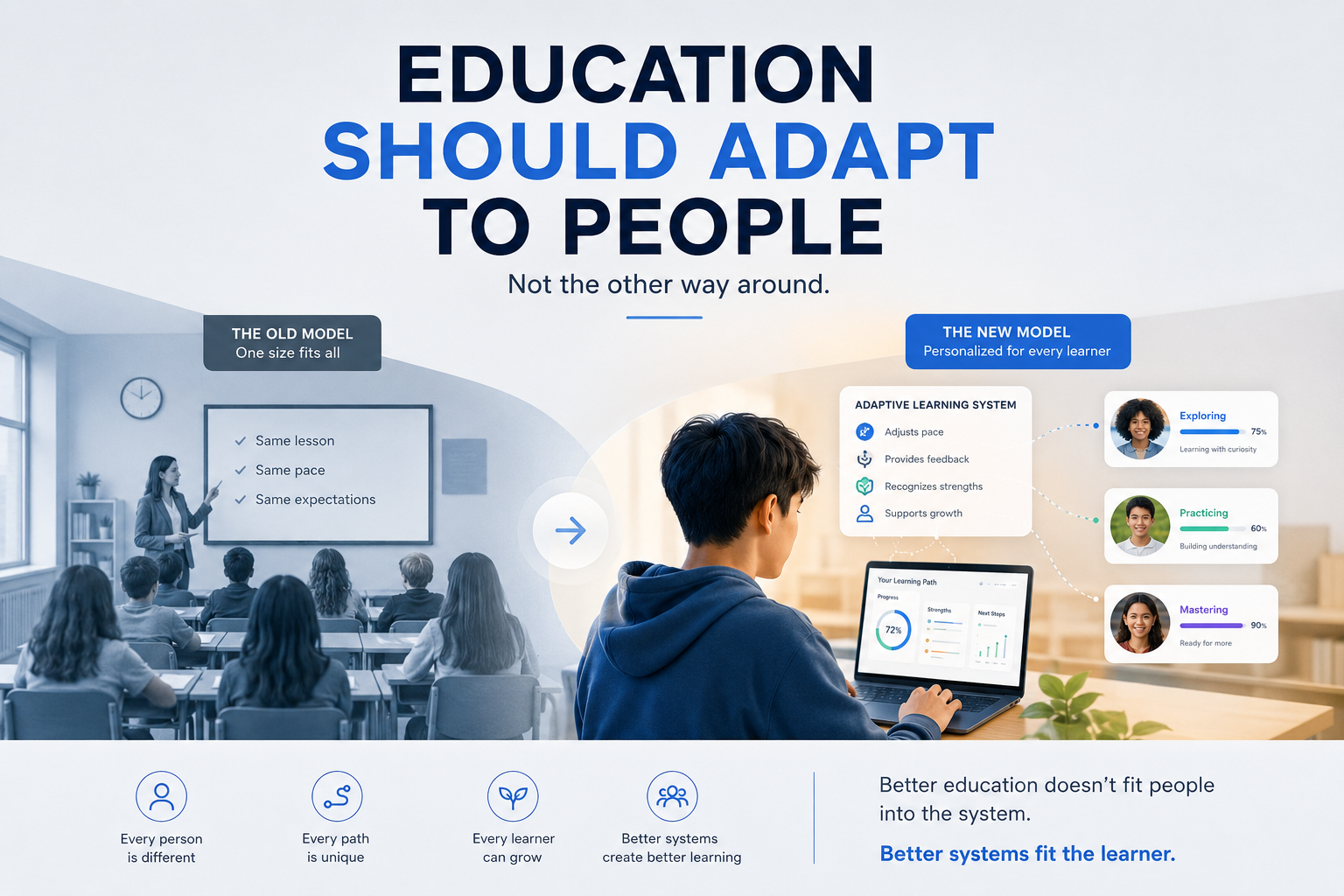
Education should adapt to people.
Not the other way around.
For decades, education has expected students to adapt to the system:
- the same lessons
- the same pace
- the same structure
Regardless of:
- interests
- abilities
- learning styles
- understanding
But people are not standardized.
Learning isn’t either.
The industrial model of education
Most modern education systems were designed for scale.
Not personalization.
Students move through the same process:
- fixed schedules
- standardized exams
- identical classrooms
- uniform expectations
The system stays rigid.
The learner is expected to adjust.
But this creates problems:
- students fall behind
- curiosity disappears
- learning becomes stressful
- education feels disconnected from real growth
The system optimizes for efficiency —
not human learning.
People learn differently
Some people learn by:
- discussion
- experimentation
- visuals
- repetition
- collaboration
Others learn faster with feedback.
Some need more time.
Some need different explanations.
Learning is deeply human.
And humans are different.
👉 A single path cannot work for everyone.
Adaptive learning changes the model
Technology — especially AI — allows us to rethink education systems entirely.
Instead of:
👉 people adapting to systems
We can build:
👉 systems that adapt to people
Where:
- pacing changes dynamically
- feedback is personalized
- difficulty evolves over time
- support appears when needed
The system becomes responsive.
Not rigid.
From standardization → personalization
Traditional education values standardization.
But the future belongs to personalization.
Not because standards are bad —
but because learning outcomes improve when systems understand people.
The goal is no longer:
- delivering the same experience to everyone
The goal becomes:
- helping every learner progress effectively
Learning becomes more human
Ironically, technology can make education feel more human.
Because adaptive systems can:
- recognize struggle
- identify strengths
- encourage curiosity
- support different learning paths
Instead of forcing everyone into one structure.
Good systems reduce friction.
They help learning feel natural.
Teachers become guides, not bottlenecks
When systems adapt intelligently, teachers gain something valuable:
👉 time
Instead of spending most of their energy on:
- repetitive grading
- manual tracking
- administrative work
They can focus on:
- mentoring
- motivation
- discussion
- meaningful guidance
Technology should support teachers —
not replace them.
What I’m building
At Hischool, we are exploring:
- collaborative learning systems
- adaptive learning environments
- community-driven education
- systems designed around interaction
Not rigid classrooms.
But environments where learning adapts naturally to people.
At Gradelytic, we are building:
- AI-powered assessment systems
- personalized feedback loops
- adaptive evaluation workflows
- insights into how students actually learn
Not just grading tools.
But systems that help educators better understand learners.
Final thought
For too long, education has asked people to fit into systems.
The future will belong to systems that fit people.
👉 Education should adapt to people — not the other way around.