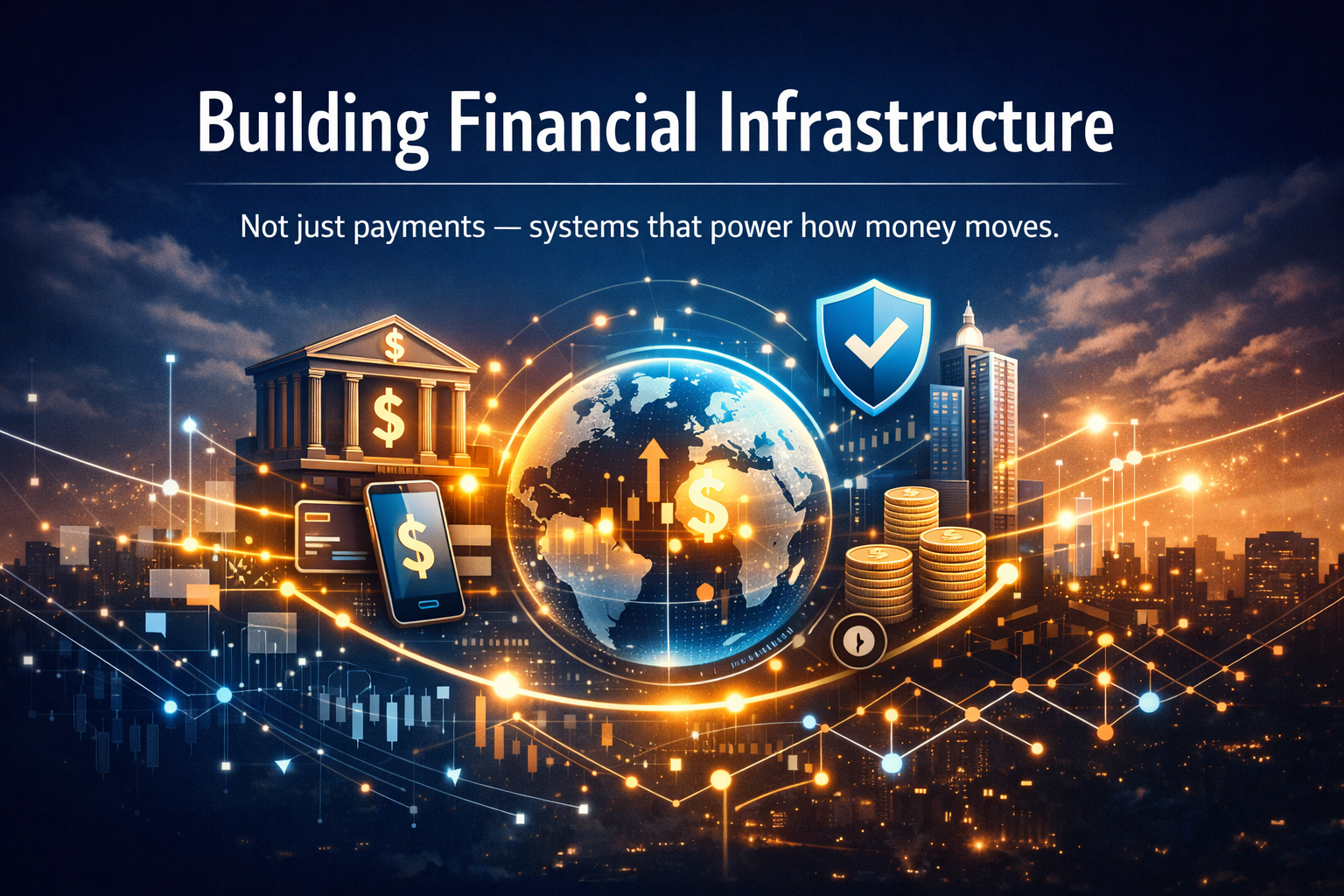
Most people think financial infrastructure is about payments.
It’s not.
It’s about how money moves through systems.
More than payments
When people hear “fintech”, they think:
- payments
- wallets
- cards
But these are just interfaces.
Behind them, there are systems:
- billing
- subscriptions
- revenue flows
- settlements
Financial infrastructure is what makes all of this work.
Every product becomes a financial system
Modern products are not just products anymore.
They are:
- subscription-based
- usage-based
- transaction-driven
That means:
👉 every product is also a financial system
If your billing breaks, your business breaks.
The hidden complexity
Financial systems look simple from the outside:
👉 “Charge the user”
But inside:
- pricing logic
- invoices
- taxes
- discounts
- failed payments
- retries
- reporting
This complexity grows fast.
Most teams underestimate it — until it breaks.
From features → infrastructure
Many startups treat billing as:
👉 just another feature
So they:
- hack it together
- patch it over time
- depend on multiple tools
But billing is not a feature.
It’s infrastructure.
It needs to be:
- reliable
- scalable
- extensible
Systems, not integrations
A common mistake:
👉 stitching tools together
- payment gateway
- invoicing tool
- analytics
But integrations create fragmentation.
Instead, we need:
👉 unified financial systems
Where:
- data is consistent
- flows are predictable
- logic is centralized
Real-time, not reactive
Traditional financial systems are:
- delayed
- batch-based
- reactive
Modern systems should be:
- real-time
- event-driven
- automated
So businesses always know:
👉 what is happening with their revenue
What I’m building
At Atmostack, I’m building:
- a unified billing system
- subscription & usage-based pricing
- automated invoicing and tax handling
- real-time revenue infrastructure
Not just tools.
👉 Systems that power how businesses make money.
Final thought
Financial infrastructure is invisible — until it breaks.
The best systems are the ones you never think about.
Because they just work.
The future of software is not just building products.
👉 It’s building the systems behind them.